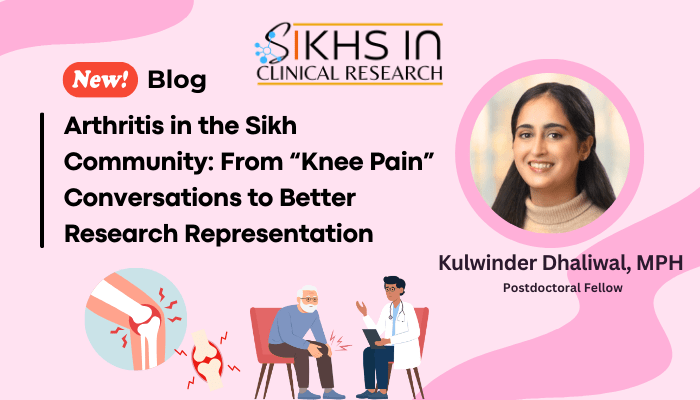
Every Sikh family knows the conversation- "Mere godya da dard", my knee pain. It happens at every gathering, every phone call home. Our elders often mention their aching joints, but it's usually dismissed as a natural part of aging. What many people don't realize is that this seemingly universal experience within our community reflects a more profound health disparity that warrants serious attention.
Disease Burden
Recent research reveals a striking reality that South Asians face significantly higher rates of rheumatoid arthritis compared to other populations. A comprehensive study analyzing over 303,000 women found that South Asian women have a 2.5 times higher prevalence of rheumatoid arthritis compared to non-Hispanic white women, the highest rate among all racial and ethnic groups studied [4].
This disparity becomes even more concerning when we look at Punjab specifically. According to the Global Burden of Disease Study 2019, Punjab experienced the highest relative increase in osteoarthritis prevalence in India between 1990 and 2019, a 14% increase that outpaced every other state except Sikkim [1]. This isn't just about aging; it reflects real health challenges affecting our community disproportionately.
Cultural Barriers to Care
A study of Punjabi women living with rheumatoid arthritis in the UK revealed how cultural factors compound the medical burden [2]. Researchers found that many women experienced profound conflicts between managing their illness and fulfilling family duties, which one participant described as "the centrality of family duty."
Perhaps most challenging was the moral dimension of illness that emerged from these interviews. Some women expressed beliefs like "I must have done something bad in my last generation, and that is why I have this arthritis" [2]. These perceptions, social and cultural barriers, led many to hide their condition entirely. As one participant noted, "A lot of times you won't find out if somebody is ill because they don't want to tell you" [2].
These cultural barriers aren’t only emotional; they carry real health consequences. When individuals delay seeking care or place family duties above their own health, arthritis may progress from manageable to function-limiting. Stronger support in balancing family responsibilities and personal health could greatly improve outcomes.
Rural Prevalence
In rural Indian communities, where many of our Sikh families originate, the burden of arthritis is cumbersome. Community-based studies show that nearly 28% of rural adults experience soft tissue rheumatism, while 12.2% live with arthritis [5]. For farming families in Punjab, the physically demanding nature of agricultural work, combined with limited access to specialized care, places an extra burden on joint health. Yet many continue working through the pain, valuing endurance and family duty, often without recognizing that these are treatable medical conditions.
Underrepresentation in Research
Despite affecting millions of South Asians, arthritis research has not prioritized the Sikh community. We know that South Asians experience some of the highest rates of rheumatoid arthritis, yet most clinical trials for new treatments have limited South Asian participation [4]. As a result, therapies may not always meet the needs of our community, and the genetic and cultural factors that shape our experiences are often left out of treatment development.
The aggregation of “Asian” data in most U.S. health studies masks important disparities [3]. When East Asian, Southeast Asian, and South Asian populations are combined, the higher rates of arthritis among South Asians are obscured by lower rates in other groups. This statistical invisibility can make the health needs of South Asian communities harder to recognize and address.
Addressing the Gap
Organizations like Sikhs in Clinical Research (SICR) are working to change this narrative. By bringing health education directly to gurdwaras (Sikh temples) and community centers, SICR helps families understand that "godya da dard" isn't just inevitable aging, it's often a treatable medical condition.
When we normalize conversations about arthritis the same way we discuss diabetes or heart disease, more people will seek timely care. When families see that managing arthritis enables our elders to continue participating in religious and cultural activities, they are often more open to treatment.
Conclusion
The Sikh community faces a disproportionate burden of arthritis, complicated by cultural barriers and research gaps. But this challenge also represents an opportunity. By learning about and participating in clinical research, our community can contribute to the development of more effective treatments tailored to the needs of Sikh populations. Discussing joint pain and arthritis openly reduces hesitation to seek care and encourages timely treatment. By supporting organizations like SICR that provide culturally competent health education, we can ensure that accurate information reaches every family.
Every grandmother facing knee pain, every farmer with aching joints after years of labor, and every young person with early arthritis symptoms deserves care that blends cultural respect with medical understanding.
It's time we change "godya da dard" from a whispered complaint into an open conversation about health, research, and community support. Our joints may ache, but our voices can drive change.
References
1. Singh, A., Das, S., Chopra, A., et al. (2022). Burden of osteoarthritis in India and its states, 1990–2019: Findings from the Global Burden of Disease Study 2019. Osteoarthritis and Cartilage, 30(8), 1070–1078. https://doi.org/10.1016/j.joca.2022.05.004
2. Sanderson, T., Calnan, M., & Kumar, K. (2015). The moral experience of illness and its impact on normalisation: Examples from narratives with Punjabi women living with rheumatoid arthritis in the UK. Sociology of Health & Illness, 37(8), 1218–1235. https://doi.org/10.1111/1467-9566.12304
3. Wise, A., Boring, M. A., Odom, E. L., et al. (2024). Racial and ethnic differences in the prevalence of patients with arthritis and severe joint pain and who received provider counseling about physical activity for arthritis among adults aged 18 years or older—United States, 2019. Arthritis Care & Research, 76(7), 1028–1036. https://doi.org/10.1002/acr.25316
4. Chen, J., Selvam, T., Darbinian, J., Macko, C., Ramalingam, N., Lo, J., & Liu, L. (2024). More than a monolith: Disaggregating rheumatoid arthritis prevalence among Asian American subgroups [Abstract]. Arthritis & Rheumatology, 76(Suppl. 9). Retrieved August 14, 2025, from https://acrabstracts.org/abstract/more-than-a-monolith-disaggregating-rheumatoid-arthritis-prevalence-among-asian-american-subgroups/
5. Joshi, V. R., Bang, A. A., Bhojraj, S. Y., et al. (2021). Clinical pattern and prevalence of rheumatic diseases among adults: A community-based cross-sectional study in rural Gadchiroli, India. Journal of Global Health Reports, 5, e2021040. https://doi.org/10.29392/001c.22240